A new propulsion principle — and what can grow out of it.
Vortifer Drive is neither a drone nor a conventional engine, but a scalable system architecture in which the propulsion system is the aircraft itself.
Vortifer in a nutshell
1. Technology
Vortifer Drive is a patented propulsion system based on toroidal vortex dynamics. The operating principle integrates thrust, stabilization, and redundancy within a single, coherent physical architecture and is designed for applications in both air and water.
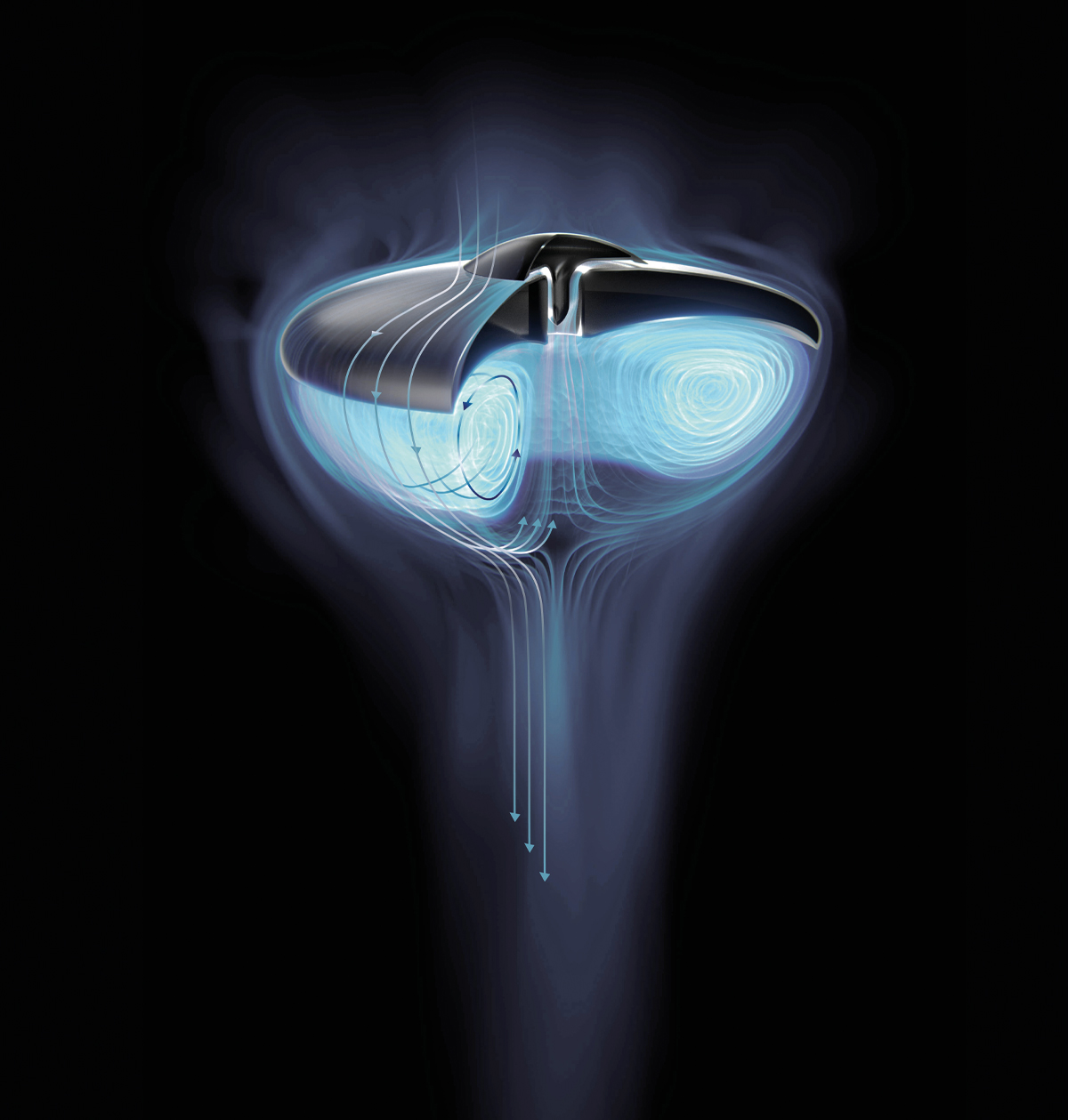
- The Vortifer Drive is based on a fluid-dynamic propulsion principle in which air is transferred into a controlled circulation process that forms a toroidal flow structure.
- Within this continuous circulation, thrust, lift, and stability are generated through an integrated physical system logic rather than through discrete individual components.
- The resulting flow structure creates a directed momentum stream acting downward and thereby generating lift in the overall system balance.
- The underlying principle has been validated: in a first test campaign, CFD simulations were correlated with measurement data from a test rig, with deviations remaining within measurement scatter. The specific characteristics of the effect depend on geometry, control, and operating condition, and will be systematically characterized and optimized on the demonstrator in the coming phase.
- In principle, the underlying mechanism can also be transferred to other fluids, including water.

- The Vortifer Drive is based on a fluid-dynamic propulsion principle in which air is transferred into a controlled circulation process that forms a toroidal flow structure.
- Within this continuous circulation, thrust, lift, and stability are generated through an integrated physical system logic rather than through discrete individual components.
- The resulting flow structure creates a directed momentum stream acting downward and thereby generating lift in the overall system balance.
- The underlying principle has been validated: in a first test campaign, CFD simulations were correlated with measurement data from a test rig, with deviations remaining within measurement scatter. The specific characteristics of the effect depend on geometry, control, and operating condition, and will be systematically characterized and optimized on the demonstrator in the coming phase.
- In principle, the underlying mechanism can also be transferred to other fluids, including water.
2. Investment in a platform
At its core is not a single product, but a technological platform that can be integrated into a range of systems or developed into complete system solutions.
The investment is therefore focused on building and scaling an IP-driven technology platform.
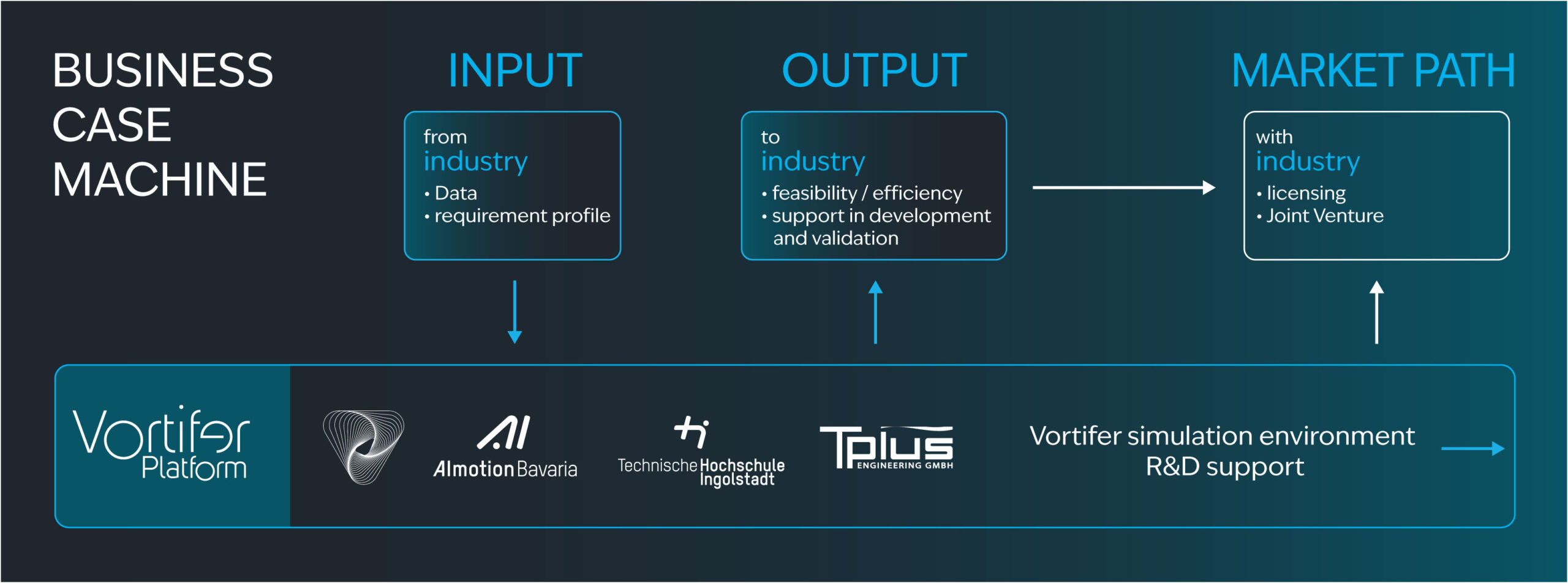
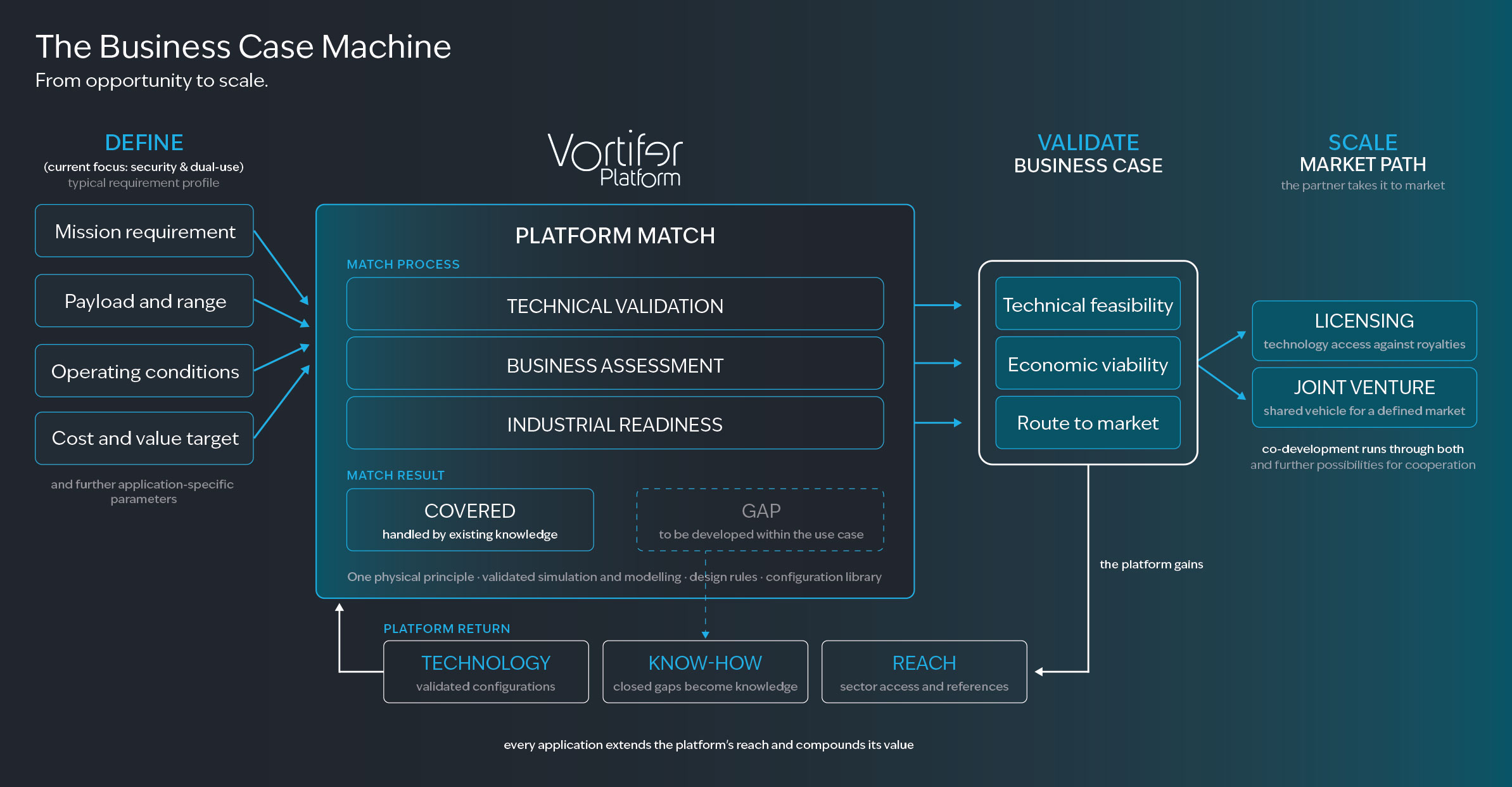
A more detailed version of the Vortifer Platform and business case logic can be found here.
3. Scalability – illustrated in one sector
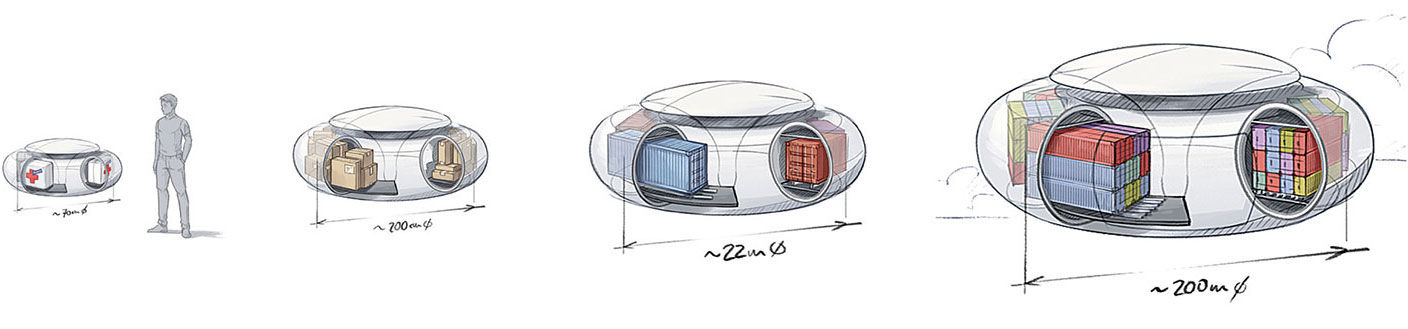
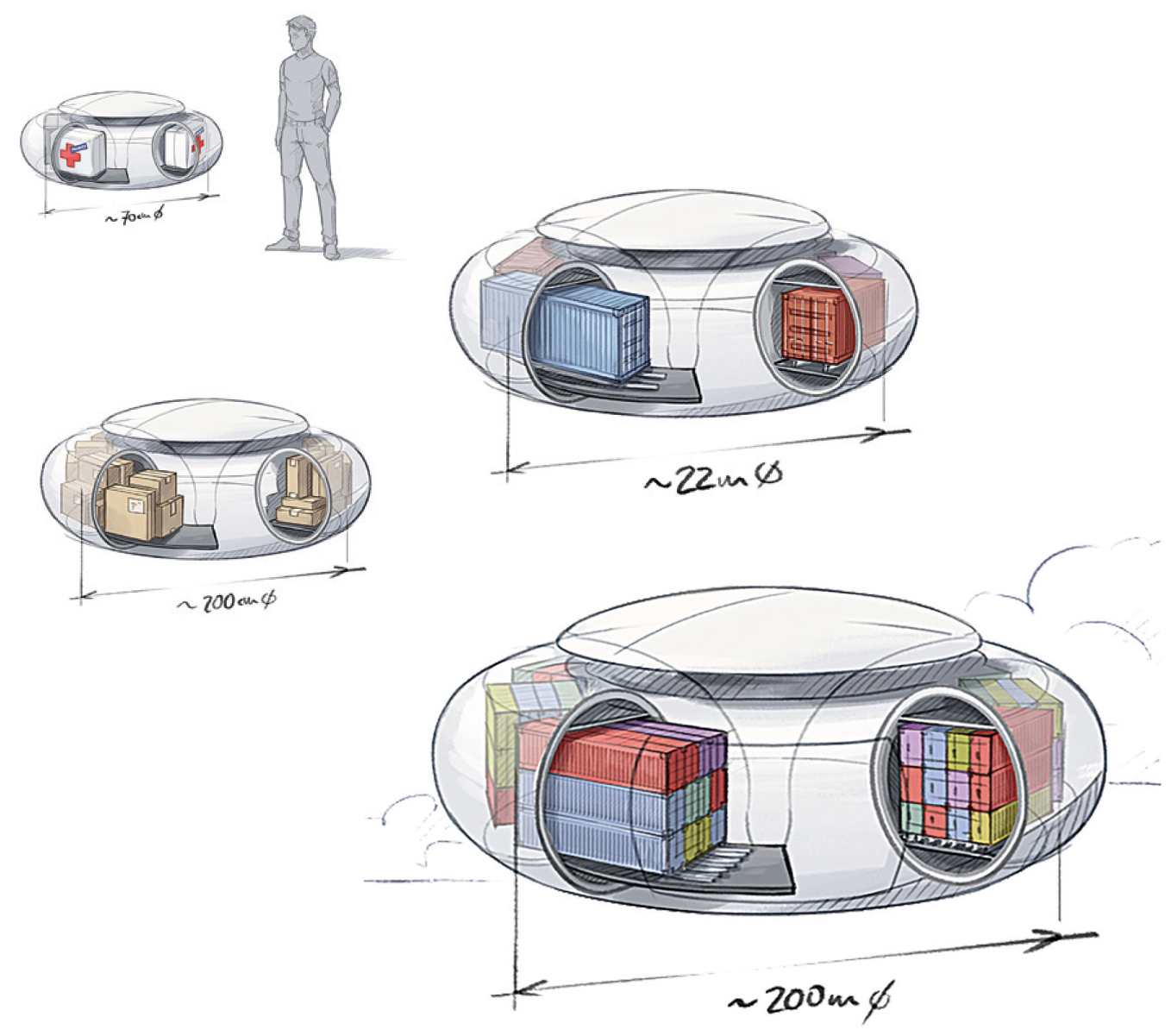
Scalability can be demonstrated through concrete application domains. In transport and logistics, it becomes evident how the same technological core can be deployed across different system configurations — and how performance and integration evolve in response to specific requirements.
4. Transfer into the platform model
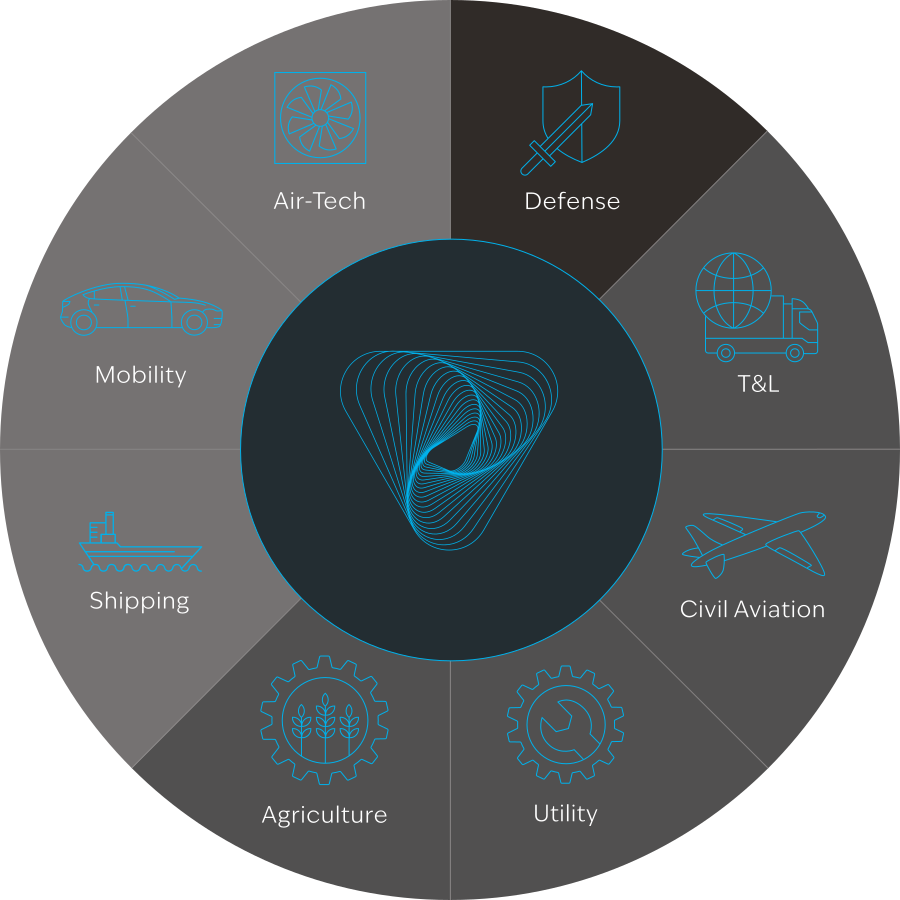
This example is intended as an illustration. In practice, scaling does not occur sequentially across individual markets, but through the structured transfer of the technological core into multiple applications.
With each implementation, the platform expands — technologically, through accumulated data, and economically.
Executive Summary
Vortifer Drive is a patented, scalable propulsion system based on a fluid-dynamic operating principle. The technology is designed such that thrust, stabilization, and redundancy are not implemented as separate components, but are inherently integrated within a unified system architecture.
The focus is no longer on feasibility, but on reproducible performance, quantitative validation, and application-driven scalability.
Vortifer addresses this challenge not through incremental modifications of existing designs, but through an alternative physical approach. Development follows a continuous chain of modelling, testing, and integration — from simulation through to deployment in industrial systems.
Commercialization is structured as a platform model: through licensing of the core technology (“Vortifer Inside”), accompanied by co-development with OEMs and system integrators leading to series integration.
The current development stage includes a validated operating principle and initial prototypes. The next step is the transition to a flight-capable demonstrator, including structured test programs and preparation for industrial integration pathways.
Vortifer Drive is at the transition from a validated core principle to reproducible system integration. The next milestone is a flight-capable demonstrator with structured validation — forming the basis for scalable partnerships and platform-based commercialization.
Technology & Validation status
- Patent protection across all major industrial regions – granted in the EU, USA, Japan, China, Israel, South Korea, and Australia, among others – Patent Overview
- Validated physical operating principle; development of a modular demonstrator platform with integrated test and measurement infrastructure for systematic investigation of aerodynamics, control, and system configurations; next phase focuses on control algorithm validation, controlled flight testing, and transition to a scalable, flight-capable demonstrator for dual-use applications in defense, security, and industry.
Technology Partners
- THI & Almotion – Development of digital system models, advanced flight control architectures, and AI-based UAV control systems.
- Tplus Engineering GmbH – Expertise in simulation-driven engineering, system analysis, and optimization of complex mechatronic and aerodynamic systems.
Together, we drive the development of the Vortifer Drive forward — from digital validation and control system design to the industrial scaling of a next-generation propulsion platform.
The Vortifer Platform
The development partners mentioned are not only involved in research and development — they form central building blocks of the Vortifer Platform. At its core is an integrated development and integration architecture in which an industrial requirement profile can be evaluated against the drive principle: what is covered, where a gap remains, and what follows from this economically?
The core of this architecture is in place and is now being extended — the investment funds its build-out, not its invention. Because technical proof alone does not create market entry. Only the mechanism that turns a requirement into a robust business case determines whether and by which route the technology reaches the market.
The platform is not a static partner network. Depending on the field of application and the industrialization path, further specialists and industrial companies can be integrated as needed. It grows with the requirements — and with each use case, its reach expands as well.
Market entry
The security and dual-use market creates a window of opportunity for new propulsion architectures. Increasing system requirements – such as reduced signature, autonomy, efficiency, and zero emissions – can no longer be addressed simultaneously with conventional approaches.
Technologies that capture this opportunity will define market standards and scale from there into civilian applications. Dual-use is the entry point, not the endpoint.
Business model & deal structures
- Licensing + engineering/integration (one-off) + volume-based royalty
- Co-development with milestone-based payments (simulation → test bench → demonstrator → series readiness)
- Application and territory exclusivity only in exchange for minimum purchase commitments or
- co-financing
Use of funds – 12 to 18 months
- Demonstrator hardware (design, manufacturing, assembly)
- Test programs: test bench, ground testing, and flight testing
- Control and software integration, including interfaces to autopilot and control systems
- Industrialization readiness: DFM/DFMEA, supplier and manufacturing setup
- Business development: pilot projects, licensing and co-development agreements, IP portfolio
Risk profile
The risk profile has shifted significantly: from open-ended technology risk to more defined execution, scaling, and market entry challenges. These are clearly structured, measurable, and manageable.
Exit – optionality rather than a single path
Exit is not a single event, but a set of strategic options: acquisition by a Tier‑1 player, platform based joint ventures, or sector-specific licensing spin-offs. Decisions are driven by strategic opportunities rather than short-term liquidity pressure.
Collaboration – An Invitation
VORTIFER opens its platform to the right partners — those who want to help shape this potential key technology:
- Family offices and deep-tech investors with a focus on hardware, aerospace, or robotics
- Strategic investors /OEMs as co-development partners (UAV/VTOL, defense, maritime)
- Enablers: testing infrastructure, manufacturing partners, certification and safety engineering
- Early adopters for pilot projects (C‑UAS/ISR, inspection, logistics)
